
Two Suns in One Sky!
The Real Story Behind Russia’s Breathtaking Sun Dog Phenomenon
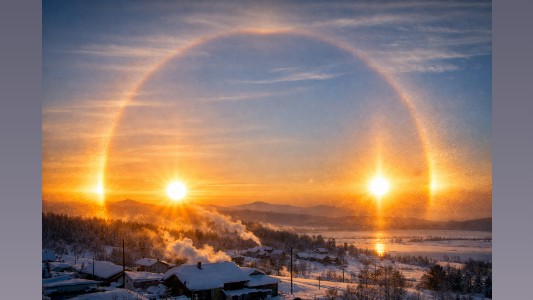
On a frigid January morning in Russia’s Sakhalin Island, residents were stunned to see what looked like two suns rising side by side in a pale winter sky. Videos and photos shared across social media quickly went viral, prompting awe, confusion, and even mythic interpretations from viewers around the world. At first glance, the scene seemed like something out of science fiction — but this astonishing visual was no cosmic anomaly. What people witnessed was a natural atmospheric miracle known as a sun dog — a rare optical phenomenon that paints the sky with twin suns.
Yet beneath the viral sensation lies a fascinating blend of physics, weather, and human perception — one that illustrates how nature’s simplest elements can create some of its most spectacular illusions.
The video you’ve shared from YouTube — “Two suns in one sky! What mystery of nature did Russia witness?” — encapsulates this phenomenon in vivid detail. Viewers see a radiant brighter point to one side of the real Sun, shining at the same elevation and almost as intensely, giving the impression of two suns in the sky simultaneously.
This wasn’t a trick of the camera or a post-production effect — these visuals were recorded live in Sakhalin, became trending topics on social platforms, and sparked thousands of reactions worldwide. As one social media comment put it: “This looks like a double sunrise straight out of a fantasy movie!” — a reaction that reflects both the beauty and mystery of the sight.
But science tells a deeper story.
The optical spectacle residents observed isn’t a second star or an alternate sun, but a well-documented atmospheric effect known as a sun dog — also called a mock sun or parhelion.
A sun dog is an atmospheric optical phenomenon that occurs when sunlight is refracted — that is, bent — by countless tiny ice crystals suspended in the air. When these hexagonal, plate-shaped crystals act like thousands of microscopic prisms, light is split and redirected, creating bright spots of light on either side of the Sun. These look like luminous “companion suns” hovering beside the real one, typically at a 22-degree angle from the Sun’s position.
Meteorologists emphasize that the ice crystals must be oriented horizontally — not randomly — for the effect to occur. This alignment allows sunlight to enter one face of a crystal and exit another face angled at about 60 degrees — the exact geometry required to bend light just enough to paint these brilliant secondary suns in the sky.
Sun dogs can occur anywhere on Earth any time the Sun is above the horizon, but they are far more visible and dramatic under conditions of:
Extreme cold temperatures — particularly in high-latitude winter regions.
Thin cirrus or cirrostratus clouds high in the atmosphere.
Low Sun angles near sunrise or sunset.
In Sakhalin on the day of the viral sighting, temperatures reportedly dipped as low as –14°C, and forecasts suggested they could drop toward –23°C, conditions experts say were conducive to the formation of abundant ice crystals capable of producing the effect.
Scientists note that these conditions don’t just create sun dogs — they often accompany other atmospheric light phenomena, including halos, light pillars, and diamond dust effects.
While most people are familiar with sun dogs, this phenomenon is part of a larger family of atmospheric optics that illustrate just how complex and beautiful our skies can be.
Sun dogs are a type of halo effect — a larger category of optical displays created when light interacts with ice crystals in the atmosphere. Halos can appear as full rings around the Sun or Moon at angles of around 22° or 46°, depending on the way light is bent.
In some rare cases, more exotic effects like 120° parhelia or Liljequist parhelia can accompany the primary phenomenon, adding even more dazzling points of light to the sky.
These complex displays often occur in polar regions or extreme winter conditions, and — like sun dogs — are driven purely by the geometry of light and ice.
Although modern science explains sun dogs with elegant physics, human cultures have long recorded sightings of multiple suns in the sky — often interpreting them through myth and metaphor.
In Greek mythology, for example, the term parhelia demonstrates this blend of science and culture. The word comes from the Greek para (beside) and helios (Sun) — literally “with the Sun” — hinting at how ancient observers saw these light companions.
Across different cultures, sun dog sightings have been woven into storytelling traditions and folklore. Some early accounts speak of twin suns as omens or signs, embedding the phenomenon into human narrative long before atmospheric science could explain it.
The recent Russian event is far from the only time twin-sun illusions have captured global attention.
In January 2020, a striking image of three suns over China’s Mohe region circulated widely, also caused by a similar alignment of ice crystals.
Pilots flying over the Himalayas have documented stunning triple-sundog panoramas, where two mock suns flank the real Sun, creating a celestial trifecta against snow-capped peaks.
Even in more temperate regions, such as parts of Europe and North America, sun dogs appear occasionally in winter skies — a reminder that this optical magic is not confined to the Arctic.
So why do seemingly simple ice crystals create such profound reactions in people?
At a time when much of the world experiences weather forecasts, climate graphs, and satellite imagery, a sun dog remains an immediate, visceral connection between us and the physics of the atmosphere. For many observers in Sakhalin, the “double sunrise” was a moment that cut through the ordinary — a fleeting spectacle that reminded them of nature’s beauty and complexity.
From a scientific perspective, sun dogs help illuminate the interplay of light and matter, offering real-world examples of refraction and optical geometry. For photographers, they provide dramatic visuals that challenge how we usually frame the sky. For mythologists and cultural historians, they offer a window into how ancient societies interpreted celestial phenomena.
And for the rest of us — simply put — they make us stop and look up.
When two suns appear in the sky over Russia, it’s not a signal of cosmic upheaval — it’s a sun dog, a wondrous atmospheric illusion rooted in physics and weather.
Sun dogs are caused by sunlight refracting through ice crystals in the atmosphere, bending light into bright patches that look like secondary suns at about 22 degrees from the real Sun.
They’re most visible in cold, icy conditions, especially in winter climates where cirrus clouds and diamond-dust crystals abound.
This phenomenon has been observed worldwide, from Russia’s far north to high altitudes over mountain ranges and in communities at high latitudes.
What residents of Sakhalin witnessed was nature’s poetry written in refracted light — a reminder that even the skies we think we know well are capable of surprising us.

share your opinion...